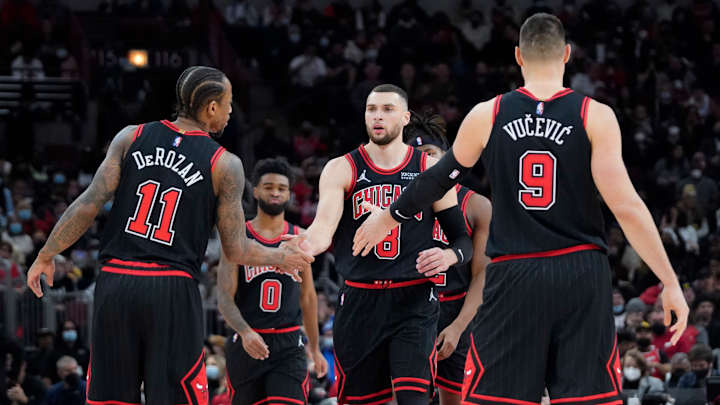
There’s no sugarcoating it: the Chicago Bulls’ defense is in shambles. Night after night, they surrender points in ways that leave fans and analysts alike shaking their heads. Relying on 35-year-old Nikola Vucevic to anchor a unit already riddled with holes has proven insufficient. Case in point: without Vucevic protecting the paint, Chicago gave up a jaw-dropping 78 points inside in a loss to the struggling New Orleans Pelicans—a number that underscores just how porous their interior defense has become.
But the problem isn’t limited to the paint. Chicago’s perimeter defense is equally troubling. Outside of Isaac Okoro, the Bulls lack reliable point-of-attack stoppers, allowing opposing wings to torch them game after game. The combination of weak interior and perimeter defense has created a perfect storm that has left the team exposed on both ends of the floor. Fans watching from the stands or the broadcast feed can see the cracks, and the urgency to address them is growing by the day.

Enter Jonathan Isaac. For a team desperate for either an intimidating shot-blocker or a long, rangy wing capable of slowing down elite scorers, Isaac represents an ideal solution. NBA insider Jake Fischer recently pointed out that Orlando’s salary situation may make Isaac a trade target: with Paolo Banchero, Franz Wagner, and Desmond Bane occupying the bulk of the Magic’s future payroll, the 6-foot-10 forward could be a casualty in the near term.
Isaac signed a five-year, $84 million deal with Orlando just over a year ago and remains under contract for nearly $60 million across the next four seasons. However, much of that money depends on him meeting appearance thresholds—specifically, 52 games in both the 2027-28 and 2028-29 seasons—after which his salary becomes fully guaranteed. With his limited role this season—averaging just 10 minutes per game—he’s not central to Orlando’s rotation, making him one of the more attainable trade targets in the league.
While rumors of Anthony Davis swirls have emerged, Isaac is clearly the more realistic target for the Bulls. The Magic likely wouldn’t require a blockbuster package to part with him; a simple salary-matching deal built around an expiring contract could suffice. Chicago has plenty of that flexibility. For instance, packaging Kevin Huerter and a few second-round picks for Isaac and Jett Howard would make financial and logical sense. Huerter, a capable shooter, is somewhat redundant on Chicago’s crowded guard-heavy roster, while Orlando has shown it doesn’t view Howard as a long-term piece, declining his fourth-year option.
The trade makes sense for Orlando as well. They gain Huerter, a proven shooter, and open flexibility for their future core, while shedding the uncertainty around Isaac’s contract guarantees. Howard also provides potential upside as a sharpshooter, having improved his three-point accuracy this season to 38 percent—well above his career mark of 31 percent.
For Chicago, acquiring Isaac would instantly transform their defense. His presence alone would drastically reduce opponents’ effectiveness near the rim—Isaac is currently holding opposing players to a 10.1 percent drop in field-goal percentage and a 17.7 percent decrease within 10 feet. Paired with Howard’s shooting upside, the Bulls would address both ends of the floor in one move—a rare alignment of talent and opportunity that is hard to ignore.
In short, this trade scenario seems almost too good to be true. The Bulls get the defensive anchor they desperately need, Orlando gains a shooter and cap flexibility, and both teams align with their long-term goals. In a season where Chicago’s defense has been a glaring weakness, the addition of Jonathan Isaac could be the exact catalyst needed to shift the narrative—and perhaps salvage a defense that has otherwise left fans holding their breath.
Leave a Reply