On a warm September night at Progressive Field, Nolan Jones drove an RBI double into the gap against the Kansas City Royals, a moment that briefly felt like a reminder of what the Cleveland Guardians once believed he could be. The swing was loud, the contact authoritative, the reaction from the crowd hopeful. But as the 2025 season closed, that hit stood more as an exception than a promise fulfilled — and it underscored a reality the organization can no longer ignore: Nolan Jones’ clock in Cleveland is ticking.
The Guardians entered 2025 expecting a rebound. Instead, they got another disappointment. Jones, now 27, finished the season slashing just .211/.296/.304 with a .600 OPS as the team’s primary right fielder. For a player once projected as a middle-of-the-order bat, those numbers landed with a thud. His 72 wRC+ placed him among the least productive offensive outfielders in all of Major League Baseball. This was supposed to be the year he steadied himself. Instead, it became the year doubt grew louder.

Defensively, Jones held his ground. He committed only one error in over 600 innings in right field, posting a sterling .993 fielding percentage. His arm remains elite — 95th percentile in Arm Value, 99th percentile in Arm Strength — and few in the organization question his physical tools. The problem is simple and brutal: tools don’t score runs. Production does.
And Cleveland desperately needs production.
The Guardians’ outfield finished near the bottom of the league in both batting average and OPS last season, a weakness that repeatedly stalled an otherwise competitive roster. Jones was expected to help stabilize that group. Instead, his inconsistency at the plate magnified the issue. Strikeouts piled up. Fastballs beat him. Confidence appeared to waver.
Yet the underlying data tells a more complicated story — and that’s where this situation becomes truly fascinating.
Despite the ugly surface numbers, Jones quietly ranked in the 70th percentile in Hard-Hit Percentage at 46.7%, the best mark on the Guardians roster. His exit velocity and launch-angle sweet-spot rate (35.8%) were also above league average. In other words, when he made contact, it often came off the bat the way teams dream about. The disconnect between quality of contact and actual results is impossible to ignore.

Internally, there is a growing belief that Jones spent the last two seasons trying to be something Cleveland needed him to be rather than something he naturally is. The Guardians lacked power in the outfield, and Jones leaned into that role — sometimes at the cost of plate discipline and pitch recognition. Against fastballs alone, he graded out at negative eight runs last season, a damning figure for a hitter expected to punish velocity.
That margin for error is shrinking fast.
Late in 2025, Cleveland gave fans a glimpse of the future by promoting George Valera and Chase DeLauter. Both prospects flashed potential, athleticism, and — most importantly — upside. They represent the next wave, and their presence has changed the math. Jones may be penciled in as the starting right fielder heading into 2026, but the leash has never been shorter.
There are no minor-league options left. There is no safety net. And as Jones inches toward 30, his appeal around the league will only decline if the bat doesn’t rebound soon.
Still, the Guardians aren’t ready to close the door.
Those inside the organization point to 2023, when Jones showed flashes of being a legitimate everyday major league bat. They point to the strength, the size, the baseball IQ. They point to the arm that can shut down running games and the hard contact that suggests something more is still there. The question isn’t whether Nolan Jones can play in the big leagues. It’s whether he can do it consistently — and whether he can do it now.
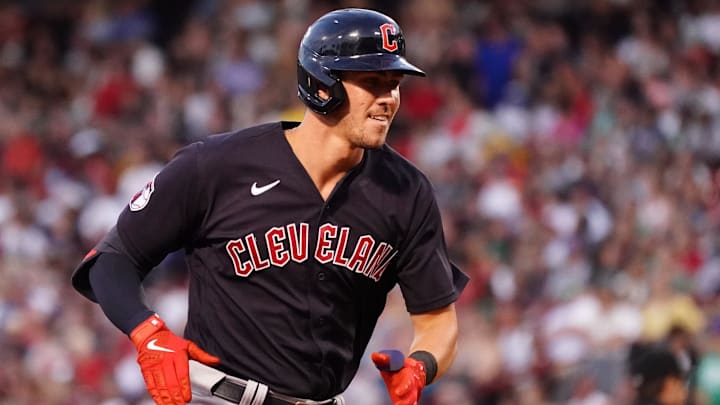
If he trims the strikeouts, refines his approach against fastballs, and stops pressing to be the savior of a flawed outfield, Jones could still settle in as a league-average contributor. On a team like Cleveland, that matters. Winning teams are often defined not by stars alone, but by the players who hold the margins.
For now, hope is all the Guardians have.
Spring Training looms less than two months away, with Cleveland set to open exhibition play against the Cincinnati Reds on February 21 at 3:05 p.m. EST. Those games won’t decide the season — but for Nolan Jones, they may decide his future.
Because in 2026, it’s no longer about potential.
It’s about survival.
Leave a Reply