On New Year’s Day 2026, as the Gregorian calendar turned and New York City stepped into a new chapter, a moment unfolded on the steps of City Hall that many observers immediately described as historic. Senator Bernie Sanders, an 84-year-old Independent from Vermont who identifies as Ashkenazi Jewish, administered the oath of office to Zohran Mamdani, a 34-year-old Indian Ugandan immigrant and Democratic Socialist, using the Quran. With that act, Mamdani was sworn in as Mayor of New York City.
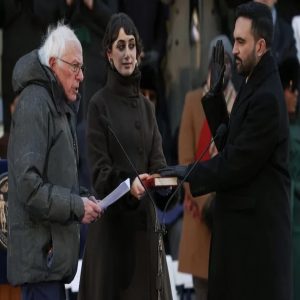
The image alone carried symbolic weight: an elder statesman known for decades of advocacy for economic justice, standing beside a new mayor whose rise reflects the city’s changing demographics and political energy. For supporters, the ceremony represented a striking expression of pluralism—faiths, backgrounds, and generations intersecting in a shared civic ritual.
Mamdani, who identifies as Muslim, chose to be sworn in on the Quran as a reflection of his personal faith and values. In doing so, he followed a long American tradition that allows elected officials to select a text meaningful to them. Across U.S. history, presidents, lawmakers, and judges have sworn oaths on Bibles, Qurans, Hebrew Bibles, law books, and even no text at all. What made this moment distinct was not the choice itself, but the broader political and cultural context in which it occurred.
Supporters described the inauguration as a powerful demonstration of unity in diversity. To them, it symbolized the possibility of sharing power peacefully across lines of religion, ethnicity, and ideology—an idea central to New York City’s identity as a global metropolis. Many pointed to the contrast between Mamdani’s immigrant background and the traditional image of American political leadership, arguing that his rise illustrates how democratic systems can evolve to reflect the people they serve.
“This is what New York looks like,” said one attendee at the ceremony. “Different histories, different beliefs, standing together under the same Constitution.”
Bernie Sanders’ role added another layer of meaning. Long known as an outsider within national politics, Sanders has built his career around challenging entrenched power and advocating for working-class Americans. His participation in the swearing-in was widely interpreted as an endorsement not only of Mamdani’s leadership, but of a broader political vision rooted in social justice, inclusion, and economic reform.
Yet the moment also exposed deep divisions. Critics reacted sharply, framing the ceremony as provocative or ideological rather than ceremonial. Some conservative commentators argued that the symbolism was being used to advance a political agenda, while others expressed discomfort rooted in religious or cultural anxieties. On social media, the inauguration quickly became a flashpoint in ongoing debates about immigration, national identity, and the role of religion in public life.
Political analysts note that such reactions are not new. Throughout American history, expansions of political inclusion—from Catholic presidents to Jewish senators to Muslim members of Congress—have often been met with resistance as well as celebration. What changes, they argue, is the speed and intensity with which these debates now unfold in the digital age.
“Mamdani’s inauguration didn’t create these tensions,” said one political historian. “It revealed them.”
The mayor himself struck a conciliatory tone in his inaugural address, emphasizing shared values rather than differences. He spoke about housing affordability, public transportation, climate resilience, and dignity for working families—issues that cut across religious and ethnic lines. While acknowledging the symbolism of the day, Mamdani focused on governance, framing his administration as one committed to practical solutions and collective responsibility.
Still, supporters and critics alike recognize that symbolism matters. For many young New Yorkers, especially immigrants and people of color, the ceremony offered representation rarely seen at the highest levels of city government. For others, it challenged long-held assumptions about who leads and how leadership should look.
The phrase “years of healing and repair work” echoed among commentators reflecting on the moment. While the inauguration marked progress for some, it also underscored unresolved tensions around race, religion, and political power in the United States. Trust, analysts note, is not built in a single ceremony, no matter how historic.
Looking ahead, the real test of Mamdani’s mayoralty will not rest on the symbolism of his swearing-in, but on his ability to govern effectively in one of the world’s most complex cities. New York faces persistent challenges—rising living costs, infrastructure strain, climate risks, and political polarization—that will demand coalition-building and compromise.
As the city moves forward from this moment, reactions to the inauguration reveal as much about the nation as they do about New York. To supporters, it stands as a reminder of democratic possibility and peaceful coexistence. To critics, it represents a cultural shift they find unsettling. Between those poles lies the reality of a diverse society still negotiating how to live together.
On January 1, 2026, under winter skies and global attention, New York City offered the country a snapshot of its future—one shaped by difference, dialogue, and the ongoing work of democracy. Whether that future becomes a model of unity or a battleground of division will depend not on a single oath, but on what follows after the ceremony ends.
Leave a Reply