WASHINGTON — Sen. Bernie Sanders sharply criticized President Donald Trump’s so-called “Big Beautiful Bill” this week, arguing that the sweeping legislation would hand massive tax benefits to the wealthiest Americans while putting millions at risk of losing healthcare coverage.
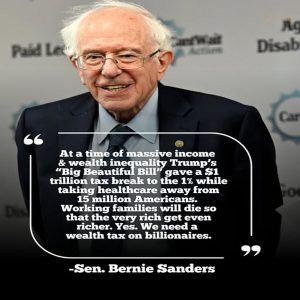
Speaking at a Capitol Hill press conference, Sanders described the proposal as “one of the most regressive pieces of legislation in modern American history,” claiming it would deliver roughly $1 trillion in tax breaks to the top 1% of income earners. At the same time, he warned that changes to federal healthcare spending embedded in the bill could result in reduced access or coverage for millions of working-class families.
“This legislation is a gift to billionaires and large corporations,” Sanders said. “You do not give a trillion-dollar tax break to the richest people in this country and then tell working families that there is no money for healthcare.”
The bill, championed by the Trump administration and supported by Republican leadership, includes a combination of tax reductions, business incentives, and restructuring of certain federal spending programs. Supporters argue it is designed to stimulate economic growth, encourage investment, and simplify aspects of the tax code. Critics, however, contend that its benefits disproportionately favor high-income individuals and large corporations.
According to summaries released by backers of the legislation, the measure would reduce certain corporate tax rates and adjust individual tax brackets. Proponents say these changes would incentivize job creation and economic expansion. Administration officials have maintained that broader economic growth would offset concerns about revenue losses and ultimately benefit Americans across income levels.
Sanders and other progressive lawmakers dispute that assessment. Citing income inequality data, Sanders argued that wealth concentration in the United States has reached levels that threaten economic stability and democratic institutions.
“The top one percent already owns more wealth than the bottom half of American society,” he said. “How much more do they need?”
At the heart of Sanders’ criticism is the healthcare component of the legislation. He claims that proposed adjustments to federal healthcare funding and eligibility standards could leave millions without adequate coverage. While administration officials say reforms are aimed at reducing waste and increasing efficiency, opponents warn of unintended consequences for low- and middle-income families.
Healthcare policy analysts note that precise impacts would depend on final bill language and state-level implementation decisions. Still, debate over potential coverage losses has become a central flashpoint in the broader political argument.
In response to what he calls “extreme and growing inequality,” Sanders renewed his call for a federal wealth tax targeting billionaires. Under his proposal, households with net worth exceeding certain high thresholds would pay an annual percentage tax on accumulated wealth, not just income. He argues that such a measure would generate substantial revenue to fund healthcare expansion, education initiatives, and infrastructure improvements.
“We are living in a moment of unprecedented wealth concentration,” Sanders said. “If we are serious about justice and fairness, we must ask the ultra-wealthy to contribute their fair share.”
Economists remain divided over the feasibility and potential consequences of a wealth tax. Supporters say it would address structural inequities and provide stable revenue. Critics question its administrative complexity, potential capital flight, and legal viability under existing constitutional frameworks.
Republican lawmakers have pushed back strongly against Sanders’ remarks. Several have accused him of mischaracterizing the bill and promoting policies they argue would stifle economic growth. They contend that reducing tax burdens on businesses and investors leads to higher wages, expanded job opportunities, and overall prosperity.
“This bill is about unleashing American enterprise,” one Republican senator said in a statement. “It’s about growth, opportunity, and keeping America competitive.”
The debate reflects broader ideological divisions over fiscal policy. Republicans often emphasize supply-side economic principles and market-driven growth strategies, while Sanders and progressive Democrats focus on redistribution, expanded social programs, and stronger regulatory oversight.
Public opinion on tax policy remains complex. Surveys consistently show broad support for higher taxes on billionaires, but Americans are also sensitive to arguments about economic competitiveness and job creation. Healthcare, meanwhile, continues to rank among the top issues for voters, intensifying scrutiny of any proposal perceived to affect coverage or affordability.
Political analysts suggest the clash over the “Big Beautiful Bill” could become a defining issue in upcoming elections. For Republicans, the measure represents a fulfillment of campaign promises to reduce taxes and streamline government. For Sanders and like-minded Democrats, it serves as evidence of what they describe as a governing philosophy that prioritizes wealth at the top over working families.
Behind the rhetoric, negotiations continue as lawmakers debate amendments and procedural steps. The final shape of the legislation may shift as it moves through Congress. Compromise provisions could soften or alter some of the most contested elements.
Still, Sanders shows no sign of retreating from his broader message. In interviews and on social media, he has framed the debate as part of a larger struggle over the direction of the American economy.
“This is not just about one bill,” he said. “It’s about whether our government works for the billionaire class or for ordinary people.”
As Congress weighs the proposal, the outcome will likely influence not only tax and healthcare policy but also the national conversation about inequality, fairness, and economic power. Whether the “Big Beautiful Bill” ultimately passes in its current form or undergoes significant revision, the debate has already sharpened ideological lines and energized both supporters and critics.
For now, the battle over the legislation continues, underscoring the enduring tension between competing visions of growth and equity in the United States.
Leave a Reply