Sen. Bernie Sanders sharply criticized President Donald Trump on Saturday over escalating tensions with Iran, describing the growing confrontation as a “Trump-Netanyahu war” that he says violates both the U.S. Constitution and international law.
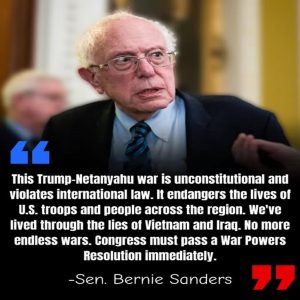
In a strongly worded post on X, the Vermont senator warned that the administration’s actions risk plunging the United States into another prolonged and costly military conflict in the Middle East. Sanders argued that the president’s approach not only bypasses Congress but also endangers American service members and civilians across the region.
“This escalating conflict endangers the lives of U.S. troops and people across the region,” Sanders wrote, cautioning that further military engagement could have devastating consequences. He framed the current crisis as part of a troubling historical pattern, drawing direct comparisons to the Vietnam War and the Iraq War—two conflicts that left deep scars on the nation’s political and social landscape.
“We’ve lived through the lies of Vietnam and Iraq. No more endless wars,” Sanders stated, echoing a message that has long defined his foreign policy stance. By invoking those wars, Sanders sought to tap into widespread public fatigue over extended overseas military engagements and skepticism toward the justifications that often precede them.
At the heart of Sanders’ criticism is his claim that the president does not have unilateral authority to initiate or expand military action without congressional approval. The U.S. Constitution grants Congress the power to declare war, a provision designed to prevent the executive branch from acting alone in matters of armed conflict. Sanders contends that any significant escalation with Iran without explicit authorization undermines that constitutional balance.
To address what he views as executive overreach, Sanders called on lawmakers to “pass a War Powers Resolution immediately.” Such a resolution would seek to limit or halt military involvement unless Congress formally authorizes it. The War Powers framework, established in 1973 following the Vietnam War, was intended to check presidential authority and ensure greater legislative oversight of military actions abroad.
Sanders’ demand signals growing concern among some members of Congress that the United States may be moving toward deeper involvement in a volatile regional conflict. Critics of the administration argue that escalating tensions with Iran could trigger retaliatory attacks, put American troops at risk, and destabilize neighboring countries already grappling with political unrest and security challenges.
Supporters of the administration, however, maintain that firm action is necessary to deter threats and protect U.S. interests and allies. They argue that demonstrating strength can prevent further aggression and maintain regional stability. The White House has defended its strategy as measured and focused on safeguarding national security.
Sanders rejects that characterization, instead portraying the situation as a dangerous gamble. By labeling the confrontation a “Trump-Netanyahu war,” he implied that the president is aligning closely with Israeli Prime Minister Benjamin Netanyahu’s hardline stance on Iran. Sanders has long criticized Netanyahu’s policies and has frequently advocated for a more restrained and diplomatic approach in the region.
The senator’s remarks come at a time when tensions between the United States and Iran remain high, fueled by a series of military exchanges, sanctions, and political rhetoric. Analysts warn that even limited military actions can rapidly spiral into broader conflict, particularly in a region where multiple armed groups and international actors are involved.
For Sanders, the issue extends beyond immediate security concerns. He frequently emphasizes the domestic costs of war, arguing that prolonged military engagements divert resources from pressing needs at home. In previous statements, he has pointed to healthcare, education, infrastructure, and economic inequality as areas that require urgent investment.
While his latest comments focused primarily on constitutional and legal concerns, the broader theme of his argument remains consistent: military escalation abroad often comes at the expense of working families at home. The financial burden of sustained conflict, combined with the human toll on service members and their families, is a recurring element of Sanders’ anti-war message.
The call for a War Powers Resolution could spark renewed debate in Congress over the balance of power between the legislative and executive branches. Historically, presidents of both parties have asserted broad authority as commander in chief, sometimes leading to tensions with lawmakers seeking greater oversight. Whether enough bipartisan support exists to advance such a resolution remains uncertain.
Public opinion may also shape the trajectory of the debate. After two decades of military operations in Afghanistan and Iraq, many Americans express reluctance to engage in another open-ended conflict. Polls over the past several years have shown declining support for large-scale foreign interventions, particularly in the Middle East.
As lawmakers weigh their options, the stakes remain high. A further escalation could have far-reaching consequences—not only for U.S.-Iran relations but also for global energy markets, regional alliances, and international diplomacy. Any miscalculation could intensify hostilities and complicate efforts to de-escalate tensions through negotiation.
For now, Sanders’ message is clear and urgent. He is urging Congress to reassert its constitutional authority and prevent what he sees as an unlawful expansion of military action. Whether his call gains traction among fellow lawmakers—or resonates broadly with the American public—will likely determine the next steps in a rapidly evolving crisis.
As the situation unfolds, Washington faces a critical choice: pursue further confrontation or step back from the brink. Sanders has drawn his line firmly, insisting that history’s lessons should not be ignored—and that the nation must avoid what he calls another “endless war.”
Leave a Reply