U.S. Sen. Bernie Sanders announced Sunday that he will travel to Los Angeles this week to advocate for a federal wealth tax on billionaires, pointing to what he described as an alarming surge in income and wealth inequality across the United States.
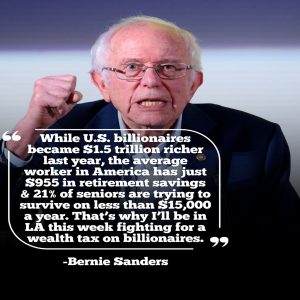
In a post on X, the independent senator from Vermont said U.S. billionaires collectively grew $1.5 trillion richer over the past year. At the same time, he noted, the average American worker has just $955 in retirement savings, and roughly 21% of seniors are attempting to survive on less than $15,000 annually. Sanders argued that those stark disparities highlight the urgent need to tax extreme concentrations of wealth.
“The gap between the very rich and everyone else has never been wider,” Sanders wrote, framing the issue as both an economic and moral crisis. He said his visit to Los Angeles will focus on rallying support for legislation aimed at imposing higher taxes on the nation’s wealthiest individuals.
Sanders has long been one of Congress’s most vocal critics of income inequality. Throughout his presidential campaigns and Senate career, he has pushed for structural reforms to the tax system, arguing that billionaires and large corporations should contribute a larger share to fund social programs. His proposals have included annual taxes on net worth above certain thresholds, often targeting individuals with tens or hundreds of millions of dollars in assets.
Los Angeles, where Sanders plans to make his case, serves as a potent backdrop for the debate. The city is home to significant wealth and high-profile billionaires, but it also faces a severe housing affordability crisis and a large population of seniors living on fixed incomes. By choosing LA as the venue for his advocacy, Sanders appears to be highlighting the visible contrast between extreme wealth and economic hardship.
According to Sanders, the data he cited illustrate a system that disproportionately benefits the ultra-wealthy. He emphasized that while billionaires have seen their fortunes swell — largely driven by stock market gains, corporate profits, and rising asset values — many working Americans remain financially vulnerable, particularly as they approach retirement.
Retirement security has become an increasingly urgent concern nationwide. Many Americans rely heavily on Social Security as their primary source of income in old age. For seniors with limited savings, rising healthcare costs, housing expenses, and inflation can create significant financial strain. Sanders has frequently argued that strengthening Social Security benefits should be a national priority and has proposed expanding the program rather than cutting it.
The wealth tax Sanders supports would seek to generate federal revenue by imposing an annual levy on the net worth of ultra-rich individuals. While specific proposals have varied, they generally include graduated rates on fortunes above a high threshold — for example, 2% or more on wealth exceeding $50 million or $1 billion.
Supporters of such a policy contend that it would raise hundreds of billions of dollars over time. They argue that those funds could be directed toward bolstering Social Security, expanding Medicare, investing in affordable housing, and lowering prescription drug costs. Advocates also say that the concentration of wealth in the hands of a small number of individuals undermines economic mobility and democratic governance.
Critics, however, raise several objections. Some legal experts question whether a federal wealth tax would withstand constitutional scrutiny. Others argue that taxing net worth — rather than income — would create administrative challenges, including the difficulty of valuing complex assets like privately held businesses, artwork, or real estate portfolios.
Opponents also warn that such a tax could discourage investment or prompt wealthy individuals to relocate assets overseas. Republican lawmakers have largely opposed wealth tax proposals, describing them as punitive and economically harmful. Even among Democrats, the idea has sparked debate, with some moderates expressing concern about feasibility and enforcement.
Nevertheless, public opinion on taxing the wealthy has shown notable support in recent years. Surveys have indicated that many Americans favor higher taxes on billionaires, particularly when the revenue is tied to funding healthcare, retirement programs, or education. Sanders has often cited that public backing as evidence that the political landscape is shifting.
The senator’s latest push comes amid broader national conversations about economic fairness. Rising living costs, housing shortages, and healthcare expenses have placed pressure on households across income levels. While unemployment rates have fluctuated, many workers report feeling financially insecure, especially as retirement approaches.
Sanders has consistently framed wealth inequality as a defining issue of the modern era. He argues that when a small group accumulates extraordinary financial power, it can influence politics, policy, and the broader economy in ways that disadvantage ordinary citizens. In speeches and legislative proposals, he has called for campaign finance reforms and corporate accountability measures alongside tax changes.
As he prepares for his trip to Los Angeles, Sanders appears intent on keeping wealth inequality at the forefront of national debate. His visit is expected to include public events and meetings aimed at building momentum for legislative action.
Whether Congress will act on his proposals remains uncertain. With a divided political climate and competing fiscal priorities, major tax reforms face significant hurdles. Still, Sanders’ advocacy underscores a persistent and growing concern about how economic gains are distributed in the United States.
By drawing attention to the contrast between billionaires’ soaring wealth and seniors living on modest incomes, Sanders is sharpening a debate that is likely to shape policy discussions well beyond this week’s trip. The outcome may influence not only tax law but also the broader direction of economic policy in the years ahead.
Leave a Reply