Senator Bernie Sanders ignited a new wave of debate over wealth, power, and the future of American journalism on Wednesday after sharply criticizing billionaire Jeff Bezos for reported layoffs at The Washington Post, a newspaper Bezos has owned since 2013. At the center of Sanders’ argument was a striking contrast: massive cuts to newsroom staff alongside what he described as extravagant personal spending by one of the world’s richest men.
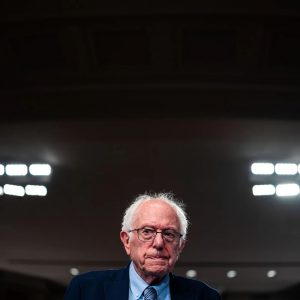
In a post on X that quickly went viral, Sanders questioned the justification for dismissing nearly one-third of the Post’s workforce while Bezos reportedly spent tens of millions of dollars on a film project, hundreds of millions on a luxury yacht, and additional millions on an ultra-high-profile wedding. “If Jeff Bezos could afford to spend $75 million on the Melania movie and $500 million for a yacht to sail off to his $55 million wedding to give his wife a $5 million ring,” Sanders wrote, “please don’t tell me he needed to fire one-third of the Washington Post staff. Democracy dies in oligarchy.”
The comment immediately resonated far beyond Capitol Hill, striking a nerve in an already tense national conversation about media consolidation, billionaire ownership of news organizations, and the economic pressures facing journalism in the digital age. Supporters praised Sanders for saying out loud what many journalists and media critics have long argued: that financial hardship is often invoked as a rationale for layoffs even as enormous wealth continues to accumulate at the top.
The reported layoffs at The Washington Post come at a difficult moment for the newspaper industry. Advertising revenues have declined sharply over the past decade, print subscriptions continue to fall, and even digital growth has slowed across much of the sector. Like many legacy outlets, the Post has been forced to rethink its business model, and executives have argued that cost-cutting measures are necessary to ensure long-term sustainability.
Yet Sanders and other critics say that explanation rings hollow when the owner of the publication is one of the wealthiest individuals on the planet. Bezos’ net worth has fluctuated in recent years but remains measured in the hundreds of billions, even after stepping down as Amazon’s CEO. For Sanders, the issue is not simply one company’s balance sheet, but what he views as a broader moral failure in a system where extreme wealth coexists with shrinking newsrooms and weakened democratic institutions.
“This is not just about Jeff Bezos,” Sanders said in a follow-up statement. “It’s about a political and economic system that allows a handful of billionaires to control enormous portions of our media landscape while working journalists lose their jobs and communities lose access to reliable information.”
Journalists’ unions and press freedom advocates echoed similar concerns. Several organizations noted that newsroom layoffs often lead to reduced investigative reporting, less local coverage, and fewer resources to hold powerful interests accountable. In that context, Sanders’ warning that “democracy dies in oligarchy” was interpreted as a direct challenge to the growing influence of ultra-wealthy owners over public discourse.
Bezos has not publicly responded to Sanders’ remarks. In past statements, however, he has defended his ownership of The Washington Post as a long-term investment in quality journalism rather than a profit-driven venture. Since purchasing the paper for $250 million in 2013, Bezos has overseen significant expansion in digital reach and staffing—at least until recent cutbacks. Supporters of Bezos argue that even billionaires cannot indefinitely subsidize losses without restructuring, and that difficult decisions are sometimes unavoidable in a rapidly changing media environment.
Still, the optics of the situation have proven difficult to ignore. Sanders’ post deliberately juxtaposed luxury spending with job losses, framing the issue in stark moral terms that are easily understood by a broad audience. Within hours, the message was shared tens of thousands of times, sparking heated debates online about corporate responsibility, wealth inequality, and the role of billionaires in shaping public institutions.
The controversy also arrives at a moment when trust in media is fragile and political polarization remains intense. For Sanders, protecting journalism is inseparable from protecting democracy itself. He has long argued that concentrated wealth undermines democratic norms, whether through campaign finance, corporate lobbying, or control over information.
“This is why we need to talk about who owns the media and why,” Sanders said during a recent interview. “A free press cannot truly exist when it depends on the goodwill of a tiny number of extremely wealthy individuals.”
As the debate continues, the future of The Washington Post and its newsroom remains uncertain. What is clear is that Sanders’ comments have reignited a national discussion about the responsibilities that come with extreme wealth—and the costs borne by workers and democratic institutions when those responsibilities are ignored.
Whether Bezos or other billionaire media owners will respond directly remains to be seen. But the message from Sanders and his supporters is unmistakable: in an era of unprecedented inequality, decisions made behind closed doors in corporate boardrooms are no longer just business choices. They are political acts with consequences that extend far beyond any single newsroom.
Leave a Reply