House Minority Leader Hakeem Jeffries has delivered a sharp message about the state of the U.S. economy, arguing that everyday life has become unaffordable for millions of Americans and placing responsibility squarely on Republican leadership. “Life is too expensive in the United States,” Jeffries said. “And Republicans have done nothing about it. You deserve better.”
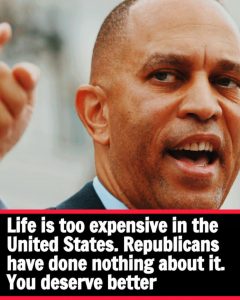
The remarks come amid ongoing public anxiety over the cost of living, even as headline economic indicators show mixed signals. Inflation has eased from its peak, but prices for housing, food, health care, and childcare remain stubbornly high. For many families, wages have not kept pace with rising expenses, leaving household budgets under pressure and fueling political frustration across party lines.
Jeffries’ comments reflect a broader Democratic strategy heading into future elections: to frame economic debates around affordability rather than abstract growth metrics. While Republicans often emphasize job creation, tax cuts, and market performance, Jeffries and other Democrats are focusing on what they describe as the lived reality of working- and middle-class Americans.
“At the end of the day, people don’t experience the economy through spreadsheets,” a senior Democratic aide said. “They experience it at the grocery store, at the gas pump, and when rent is due.”
Jeffries has argued that Republican lawmakers have failed to offer meaningful solutions to lower everyday costs. He points to repeated GOP opposition to measures such as expanding affordable housing programs, negotiating prescription drug prices, and increasing the minimum wage. In his view, these policy choices reveal a disconnect between Republican priorities and the needs of ordinary Americans.
Republicans strongly dispute that characterization. GOP leaders argue that Democratic policies have contributed to inflation through excessive government spending and regulation. They maintain that reducing taxes, cutting red tape, and limiting federal intervention would help lower costs and stimulate economic growth. From this perspective, Republicans see themselves as offering long-term economic stability rather than short-term relief.
Still, Jeffries’ message appears designed to resonate with voters who feel squeezed despite steady employment numbers. Housing costs, in particular, have emerged as a central issue. Rents and home prices have risen sharply in many parts of the country, making it harder for young people and first-time buyers to enter the market. Jeffries has called for expanded federal investment in housing supply and stronger protections for renters.
Healthcare expenses are another focal point. While Democrats have highlighted recent efforts to cap insulin prices for seniors and allow limited Medicare drug price negotiations, Jeffries argues that Republicans have consistently resisted broader reforms that could reduce costs for families. He warns that without continued pressure, progress on affordability could stall.
The Minority Leader’s remarks also carry political significance within his own party. As Democrats position themselves for upcoming national contests, Jeffries is increasingly seen as a central voice shaping the party’s economic narrative. His leadership style emphasizes disciplined messaging and a focus on kitchen-table issues, rather than ideological rhetoric.
Observers note that Jeffries’ framing echoes themes used successfully by Democrats in recent elections, where candidates focused on protecting economic security rather than promoting sweeping structural change. By telling voters “you deserve better,” Jeffries is appealing to a sense of fairness and accountability rather than partisan loyalty alone.
Some analysts have drawn comparisons between Jeffries’ approach and earlier Democratic messaging under leaders like Barack Obama, who often emphasized middle-class stability and opportunity. However, Jeffries’ tone reflects a more confrontational political environment, where trust in institutions is low and voters are demanding concrete results.
Critics within and outside the Democratic Party caution that rhetoric alone will not be enough. They argue that voters want to see tangible improvements in affordability, not just blame assignment. “People are tired of finger-pointing,” one independent policy analyst said. “They want to know what’s going to change in their daily lives.”
Jeffries acknowledges that challenge. In recent interviews, he has emphasized that Democrats must not only criticize Republican inaction but also present clear plans to reduce costs. These include expanding tax credits for families, investing in domestic manufacturing to stabilize supply chains, and strengthening antitrust enforcement to curb corporate price-setting power.
The debate over affordability is likely to intensify as election cycles approach. Polls consistently show that economic concerns rank at the top of voter priorities, often outweighing cultural or foreign policy issues. Both parties are acutely aware that perceptions of economic competence can determine electoral outcomes.
For Jeffries, the stakes are high not only for his party but for his own leadership trajectory. As Minority Leader, he is tasked with unifying Democrats around a compelling alternative vision while countering Republican narratives. His comments signal a determination to make cost-of-living issues central to that effort.
Whether voters ultimately agree with Jeffries’ assessment remains an open question. What is clear is that affordability has become a defining issue of the moment. As families continue to grapple with rising costs, political leaders on both sides will face increasing pressure to move beyond slogans and deliver solutions.
Jeffries’ message—simple, direct, and emotionally charged—captures a growing sense of impatience among Americans. “You deserve better” is more than a critique; it is a challenge. And as economic debates heat up, it may become one of the most closely watched refrains in the national political conversation.
Leave a Reply