House Democratic Leader Hakeem Jeffries delivered a stark assessment of America’s economic reality this week, arguing that Republican policies—particularly those associated with Donald Trump’s presidency—have left working families struggling and entire communities falling behind. “Life is too expensive in the United States, and things have actually gotten worse,” Jeffries said. “Working-class Americans are being hurt. Black and brown Americans are being hurt. The heartland of America is being hurt.”
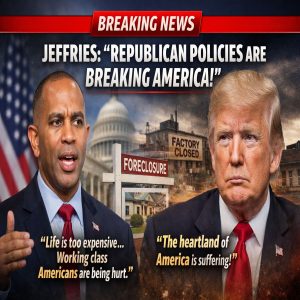
Jeffries’ remarks land at a moment of heightened anxiety for voters across the country, as prices for housing, healthcare, childcare, and food continue to strain household budgets. While economic indicators such as employment and GDP growth are often cited by Republicans as evidence of resilience, Jeffries contends those metrics mask a harsher truth on the ground—one where everyday Americans feel squeezed from every direction.
At the center of Jeffries’ argument is the idea that Republican economic priorities favor corporations and the wealthy while shifting the burden onto workers. He points to tax cuts passed during Trump’s presidency that disproportionately benefited high earners, arguing they drained public resources that could have been invested in wages, infrastructure, and social services. “When you rig the system for the top, everyone else pays the price,” Jeffries said, framing the cost-of-living crisis as a direct outcome of policy choices rather than an unavoidable economic cycle.
Housing has become a flashpoint in the debate. Jeffries cited rising rents and home prices as evidence that the market has been left unchecked, particularly in urban centers and rapidly growing regions of the Midwest and South. He argues that Republican opposition to federal housing investment and tenant protections has worsened shortages, leaving families with fewer options and higher monthly costs. “People are working full-time and still can’t afford a safe place to live,” he said. “That’s not a market failure—it’s a leadership failure.”
Healthcare costs remain another pillar of Jeffries’ critique. He accused Republicans of repeatedly attempting to weaken the Affordable Care Act without offering a credible alternative, a move he says would have raised premiums and stripped coverage from millions. For communities of color, Jeffries argues, these policies compound long-standing disparities. “When healthcare becomes more expensive or less accessible, it hits Black and brown Americans first and hardest,” he said.
Republicans, however, reject Jeffries’ framing. GOP leaders argue that inflationary pressures stem from Democratic spending and regulatory overreach, not Trump-era policies. They point to supply chain disruptions, global instability, and energy costs as primary drivers of higher prices. Some Republicans also emphasize wage growth in certain sectors and low unemployment as signs the economy remains fundamentally strong.
Jeffries counters that such arguments ignore lived experience. “You can tell people the economy is strong all day long,” he said, “but if they’re choosing between rent and groceries, they know something is wrong.” He also dismissed claims that deregulation alone would solve affordability issues, noting that decades of similar policies have failed to deliver broad-based prosperity.
The Democratic leader placed particular emphasis on the impact in rural America and the industrial heartland—regions often portrayed as Republican strongholds. Factory closures, hospital shutdowns, and declining public investment, Jeffries said, have left many towns vulnerable. “This is not just a big-city problem,” he added. “The heartland of America is being hurt, and it’s being hurt by the same policies that claim to represent it.”
Jeffries’ comments also reflect a broader Democratic strategy ahead of high-stakes elections: tying economic pain directly to Republican governance while positioning Democrats as the party of affordability and fairness. He highlighted Democratic proposals to lower prescription drug prices, expand child tax credits, and invest in domestic manufacturing as evidence of an alternative path forward. “We believe in building an economy that works for everyone, not just the well-connected few,” he said.
Still, challenges remain for Democrats. Voters frustrated by high prices are often skeptical of both parties, and trust in institutions has eroded across the political spectrum. Jeffries acknowledged the frustration, urging Americans to judge leaders by results rather than rhetoric. “People don’t want slogans,” he said. “They want relief.”
As the political battle over responsibility intensifies, Jeffries’ message underscores a central question shaping the national debate: Are rising costs the result of unavoidable global forces, or the predictable outcome of policy decisions made in Washington? For Jeffries, the answer is clear—and urgent.
“America can do better,” he said. “But only if we stop repeating the same failed policies and start putting working people first.”
With voters incrementally tuning out partisan talking points and tuning in to their own bank balances, Jeffries’ warning may resonate far beyond Capitol Hill. Whether it reshapes the political landscape—or hardens existing divides—will depend on which vision of the economy Americans ultimately believe reflects their reality.
Leave a Reply