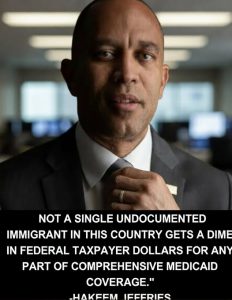
House Minority Leader Hakeem Jeffries is facing renewed criticism after stating that “not a single undocumented immigrant in this country gets a dime in federal taxpayer dollars for any part of comprehensive Medicaid coverage.” The remark, delivered amid a broader debate over immigration and public spending, has become a flashpoint in Washington, with opponents calling the statement misleading and emblematic of a deeper disagreement over how the nation’s healthcare safety net is funded and who ultimately benefits from it.
At the center of the dispute is the distinction between “comprehensive” Medicaid coverage and other forms of taxpayer-funded care. Jeffries’ defenders argue that his statement is technically accurate: undocumented immigrants are not eligible to enroll in full Medicaid programs that provide ongoing, comprehensive benefits. Critics, however, say that focusing on the word “comprehensive” obscures a significant reality. They point out that emergency Medicaid—funded by taxpayers—covers hospitalizations, childbirth, and life-saving treatments for undocumented immigrants, and that these costs add up to billions of dollars nationwide each year.
Emergency Medicaid is designed as a limited program, intended to ensure that hospitals can provide urgent care regardless of a patient’s immigration status. Yet opponents argue that its scale and cost have grown dramatically, especially in states with large migrant populations. They contend that while the program may not fit the definition of comprehensive coverage, it nonetheless represents a substantial federal expenditure that contradicts the broader impression left by Jeffries’ statement.
The criticism does not stop at federal policy alone. Opponents also highlight state-level practices, particularly in California and New York, where they argue federal rules have been interpreted or stretched to expand healthcare access for undocumented residents. These states have pursued policies aimed at broadening coverage, often using a mix of state and federal funds. Critics claim that this approach effectively shifts some of the financial burden onto federal taxpayers, even if it technically complies with existing regulations.
According to these critics, the impact is felt most acutely by legal residents and citizens. They argue that increased demand on healthcare systems has contributed to longer wait times, higher insurance premiums, and strained hospital resources. Veterans’ groups and advocates for low-income citizens have voiced concerns that limited funds are being spread thinner, leaving vulnerable Americans competing for services they believe should prioritize those with legal status.
Many opponents link these pressures to migration trends during the Biden-Harris years. They argue that increased migration has intensified demand for emergency healthcare services, amplifying costs and logistical challenges for states and hospitals. In this view, the debate over Jeffries’ wording is less about semantics and more about accountability for policies that critics say have allowed costs to rise without sufficient oversight.
Supporters of former President Donald J. Trump have seized on the controversy to draw a sharp contrast with what they describe as his second-term agenda. They argue that Trump’s approach directly addresses the concerns raised by critics of current policy. According to these supporters, tighter oversight at the Centers for Medicare & Medicaid Services (CMS), closer scrutiny of state spending, and efforts to close perceived loopholes are central to reducing strain on the healthcare system.
Trump’s allies say stronger enforcement and clearer eligibility rules would help ensure that federal healthcare dollars are directed toward citizens, veterans, and lawful immigrants first. They frame this as a core element of an “America First” philosophy—one that prioritizes fiscal responsibility while maintaining a safety net for those legally entitled to it. In their view, such reforms could save billions of dollars over time and restore public confidence in federal programs.
Advocates of this approach also point to broader economic indicators to support their argument. They cite periods of economic growth, easing inflation, and improved border enforcement as evidence that stricter policies can coincide with stronger outcomes for American families. They argue that when borders are better managed and spending is more tightly controlled, resources are freed up for infrastructure, veterans’ care, and domestic priorities.
Democrats, meanwhile, push back against these claims. They argue that emergency Medicaid is a necessary public health measure, not a discretionary benefit, and that denying urgent care would be both unethical and more costly in the long run. Hospitals, they note, are legally and morally obligated to provide life-saving treatment, and emergency Medicaid ensures that providers are at least partially reimbursed, preventing costs from being shifted entirely onto hospitals or insured patients.
From this perspective, Jeffries’ statement reflects a legitimate distinction between comprehensive benefits and emergency services. Democrats argue that critics are conflating the two to score political points, and that broader reforms should focus on improving system efficiency rather than restricting access to urgent care.
Still, the controversy underscores how deeply polarized the debate over immigration and healthcare has become. What might once have been a technical discussion about eligibility rules now serves as a proxy for competing visions of government responsibility, national identity, and fiscal priorities. Language matters in this environment, and even a single word—such as “comprehensive”—can become a lightning rod.
As Congress continues to grapple with budget negotiations, immigration reform, and healthcare funding, the debate sparked by Jeffries’ comment is unlikely to fade. For critics, it highlights what they see as a pattern of minimizing costs and consequences. For supporters, it reflects a defense of existing law and a rejection of what they view as misleading narratives.
Ultimately, the dispute is about more than Medicaid. It is about trust—trust in political leaders to speak plainly, trust in institutions to manage taxpayer dollars responsibly, and trust that policies will balance compassion with accountability. As both sides marshal statistics, anecdotes, and economic arguments, the American public is left to weigh not only the facts, but the values that shape how those facts are presented.
In an election season already defined by sharp contrasts, the Medicaid debate adds another layer to the broader struggle over who benefits from government programs and how the nation defines fairness in an era of economic and demographic change.
Leave a Reply