New York City Mayor Zohran Mamdani issued a forceful rebuke of a U.S. military operation against Venezuela on Tuesday, condemning what he described as an unlawful act of war after being briefed on the capture of Venezuelan President Nicolás Maduro and his wife. According to Mamdani, the pair are being transported to the Metropolitan Detention Center (MDC), a federal facility in Brooklyn, where they are expected to be held in U.S. custody pending further legal proceedings.
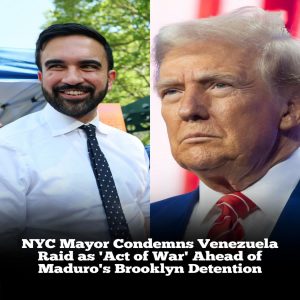
In a sharply worded social media post, Mamdani said the operation crossed legal and moral lines, arguing that “unilaterally attacking a sovereign nation is an act of war and a violation of federal and international law.” The mayor framed his opposition not only as a matter of foreign policy but as an issue with immediate consequences for New York City, home to one of the largest Venezuelan communities in the United States.
“This blatant pursuit of regime change doesn’t just affect those abroad,” Mamdani wrote. “It directly impacts New Yorkers, including tens of thousands of Venezuelans who call this city home.” His statement quickly circulated online, drawing both praise and criticism as national leaders and legal experts began debating the implications of the operation.
Federal officials have not publicly detailed the scope of the mission or the legal basis for Maduro’s arrest and transfer to U.S. soil. However, sources familiar with the matter said the operation was coordinated by U.S. agencies and involved international partners. The Metropolitan Detention Center, which houses high-profile federal detainees, has been placed under heightened security, according to law enforcement officials.
Mamdani said he was briefed by federal authorities shortly before news of the transfer became public. While acknowledging that the city does not control federal detention facilities, the mayor emphasized that New York would inevitably feel the ripple effects of the decision. “Our city is a global one,” he said in a follow-up statement. “When the United States takes actions of this magnitude, New Yorkers are not insulated from the consequences—socially, politically, or emotionally.”
Venezuelan community leaders across the five boroughs echoed those concerns. Many expressed fear that the operation could inflame tensions, trigger retaliation abroad, or deepen divisions within diaspora communities already grappling with trauma from years of political instability at home. “People are scared and confused,” said one community organizer in Queens. “Some oppose Maduro, others don’t, but everyone worries about what this means for their families and for Venezuela.”
Legal scholars also weighed in, noting that the capture of a sitting head of state raises complex questions under international law. While some argue that allegations against Maduro could justify extraordinary measures, others warn that bypassing multilateral institutions sets a dangerous precedent. Mamdani aligned himself with the latter view, stressing that accountability must come through lawful, international processes rather than unilateral force.
“This is not how justice is supposed to work,” Mamdani wrote. “If the United States claims to stand for the rule of law, it must follow it—even when it is inconvenient.”
The White House has yet to respond directly to Mamdani’s comments, though administration officials have defended the operation in general terms, citing national security interests and long-standing concerns about Venezuela’s leadership. Supporters of the action argue that it represents a decisive step against authoritarianism and corruption, while critics say it risks escalating conflict and undermining global norms.
Within New York’s political landscape, Mamdani’s stance marks one of the strongest condemnations from a major city leader. Some local officials praised the mayor for speaking out, saying his comments reflect the values of a diverse city with deep international ties. Others accused him of overstepping his role and interfering in matters of federal authority.
Despite the backlash, Mamdani remained defiant, reiterating that city leaders have a responsibility to speak when global actions have local consequences. He announced plans to meet with Venezuelan community organizations and civil rights groups in the coming days to address concerns and ensure that New Yorkers are not unfairly targeted or stigmatized amid heightened tensions.
As Maduro and his wife are expected to arrive at the Brooklyn facility, protests and demonstrations are already being planned by groups on both sides of the issue. For many New Yorkers, the episode underscores how closely intertwined global events and local realities have become.
“This moment will be judged not just by what it achieves abroad,” Mamdani said, “but by whether we chose law over force and humanity over power.”
Leave a Reply