More than five years after the death of financier Jeffrey Epstein shook the nation, a newly released Justice Department document is reigniting scrutiny over the official timeline of events.
At the center of the renewed attention is a federal record dated August 9, 2019 — one day before Epstein was publicly reported dead. According to official accounts, Epstein was found unresponsive in his cell at the Metropolitan Correctional Center in Manhattan on the morning of August 10, 2019. He had been awaiting trial on federal sex-trafficking charges at the time.
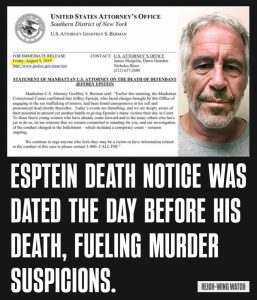
However, the newly surfaced document contains language stating: “Epstein… was found unconscious in his cell and pronounced dead shortly thereafter.” The issue drawing concern is not the wording itself, but the date attached to the record. The August 9 timestamp appears to predate the morning when authorities say Epstein was discovered.
The discrepancy has prompted fresh questions from legal analysts and observers who have followed the case closely since 2019. While clerical errors are not uncommon in bureaucratic paperwork, critics argue that the unusual timing fuels long-standing skepticism surrounding the circumstances of Epstein’s death.
Federal officials have consistently maintained that Epstein died by suicide. The conclusion was reached by the New York City Office of Chief Medical Examiner following an autopsy. At the time, authorities stated that Epstein hanged himself in his jail cell while awaiting trial.
Yet from the outset, the case was shadowed by controversy.
Epstein had previously been placed on suicide watch after an earlier incident in custody. He was later removed from heightened monitoring and transferred to a special housing unit. On the night before his death, two correctional officers assigned to guard his unit reportedly failed to conduct required checks. Court filings later revealed that the officers admitted to falsifying records related to their monitoring duties.
Compounding public doubts were reports that surveillance cameras outside Epstein’s cell malfunctioned or failed to capture usable footage during critical hours. Those failures became focal points in widespread criticism of the Bureau of Prisons and sparked internal investigations.
The newly disclosed August 9 document does not explain why its reference to Epstein’s death appears to precede the official timeline. Nor does it clarify whether the date reflects when the document was drafted, processed, or entered into a records system. As of now, authorities have not publicly addressed the discrepancy or provided additional context about the record.
Epstein’s death occurred during the first term of then-President Donald Trump. The financier had long moved within elite social circles that included politicians, business leaders, and celebrities. Past photographs and public records documented a social relationship between Trump and Epstein years earlier, though Trump later said they had a falling out.
Because of Epstein’s connections to powerful figures across political and social spheres, his death quickly became the subject of intense public speculation. Lawmakers from both major political parties called for investigations into jail procedures and transparency in the case.
Then-Attorney General William Barr described Epstein’s death as the result of a “perfect storm of screw-ups,” citing significant failures within the federal jail system. Barr said he was “appalled” by the breakdown in protocol at the Manhattan facility.
Still, public skepticism has endured. For some observers, unanswered logistical questions — including staffing shortages, missed security checks, and technical malfunctions — created an environment ripe for doubt. Others have argued that Epstein’s high-profile status and the gravity of the charges against him warranted stricter safeguards.
The resurfacing of the August 9 record has added another layer to that ongoing scrutiny.
Legal experts note that discrepancies in dates can sometimes stem from administrative processing practices. Draft statements may be prepared in advance of formal confirmation, or metadata timestamps may reflect when a template was created rather than when an event occurred. Without official clarification, however, the document leaves room for interpretation.
Transparency advocates say that even minor inconsistencies can carry outsized consequences in cases already clouded by mistrust. In high-profile matters involving public institutions, small clerical ambiguities can quickly evolve into broader credibility concerns.
Epstein’s arrest in July 2019 on federal charges marked a dramatic turn in a case that had already spanned more than a decade. His earlier 2008 plea deal in Florida had drawn heavy criticism for its leniency. The 2019 indictment accused him of operating a sex-trafficking ring involving underage girls, allegations he denied before his death.
Because Epstein died before standing trial, the criminal case against him was formally dismissed. However, investigations into associates and related civil litigation have continued in the years since.
For many, the unanswered questions surrounding his death remain intertwined with broader concerns about accountability and transparency in the justice system. The combination of jail failures, high-profile connections, and procedural inconsistencies has kept the case in public discourse long after the initial headlines faded.
The Justice Department has not indicated whether the newly surfaced document will prompt additional review. No new investigative steps have been publicly announced in connection with the dating discrepancy.
Five years on, Epstein’s death remains one of the most debated custodial deaths in recent memory. Each new document release, however minor, tends to reopen discussions that never fully settled.
Whether the August 9 date ultimately proves to be a simple administrative anomaly or something requiring deeper explanation, its emergence underscores a reality that has defined the case from the beginning: questions about how and why Epstein died have never entirely gone away.
And until every inconsistency is clearly addressed, renewed scrutiny is likely to follow.
Leave a Reply