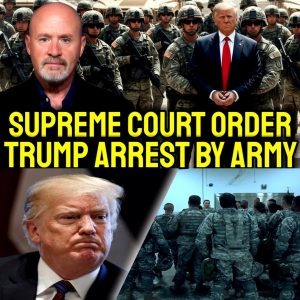
The claim spread fast and hit hard: that the Supreme Court had ordered the U.S. Army to arrest Donald Trump. It sounds explosive—and it is false. No such order exists, and the Constitution gives the Court no authority to command the military in that way. But the viral headline obscures a real and troubling debate now unfolding among legal experts, veterans, and constitutional scholars: what happens when a political leader speaks about the military as if it were a partisan tool?
The renewed scrutiny follows a speech Trump delivered to senior military leaders that critics say crossed a dangerous line. According to analysts, including retired Army Judge Advocate General (JAG) officer and military law professor Dan Maurer, the speech blurred the boundary between civilian politics and military professionalism. Trump’s remarks reportedly included partisan jabs, disparaging language toward senior officers, and references that suggested using American cities—and civilians—as military “training grounds.” For experts steeped in military law, that rhetoric set off alarms.
“The U.S. military exists to defend the nation from external threats,” Maurer has argued. “It does not exist to police domestic politics or serve as a political weapon.” Under the Constitution, the armed forces are subordinate to civilian control—but that control is constrained by law. Orders must be lawful. Commands that violate constitutional rights or federal statutes are not just improper; they must be refused.
This is where the misunderstanding becomes dangerous. The idea that a president could direct troops against American civilians for political purposes runs headlong into legal prohibitions, including limits on domestic military deployment and the military’s long-standing norm of nonpartisanship. While there are narrow, lawful circumstances for domestic use of forces—such as disaster response or specific statutory authorizations—using soldiers to intimidate, punish, or “train” on civilians would be unlawful.
Legal commentators like Glenn Kirschner, a former federal prosecutor who now analyzes rule-of-law issues publicly, have emphasized the distinction between heated rhetoric and legal reality. The Supreme Court does not issue arrest orders, let alone command the Army. Arrests are carried out by law enforcement pursuant to warrants issued by courts, based on probable cause. The military is not a domestic police force, and the Court does not bypass constitutional processes to deploy it.
Still, experts say the concern is not hypothetical. Words matter—especially from someone who has held the nation’s highest office. When a leader speaks as if the military is an extension of a political movement, it risks eroding norms that protect both democracy and the armed forces themselves. The U.S. military’s credibility rests on its apolitical stance; once that is compromised, public trust is harder to rebuild.
What reassured many observers, Maurer included, was the reported response of senior commanders in the room. Described as stoic and nonpartisan, their demeanor signaled adherence to professional norms and the rule of law. In the American system, military leaders are trained not only to execute lawful orders but also to recognize and refuse unlawful ones. That quiet discipline is a safeguard rarely seen—but often relied upon.
The episode has also revived a broader civic education problem. Viral headlines thrive on fear and confusion, often conflating commentary with official action. The claim about a Supreme Court-ordered arrest by the Army gained traction precisely because it played into existing anxieties. Experts warn that misinformation can be just as corrosive as misconduct, weakening public understanding of how institutions actually function.
None of this means rhetoric is consequence-free. Speech that suggests contempt for constitutional limits invites scrutiny, fuels division, and tests guardrails designed to keep the military out of politics. It also places unfair pressure on service members, who swear an oath to the Constitution—not to any individual.
As legal analysts stress, the real question is not whether an imaginary order exists, but whether Americans recognize the line that must never be crossed. Civilian leaders may set policy, but they cannot lawfully conscript the military into partisan conflict. Courts may interpret the law, but they do not command troops. And soldiers may follow orders—but only lawful ones.
In an era of viral claims and high-stakes politics, separating fact from fiction matters more than ever. The Supreme Court did not order an arrest by the Army. Yet the debate ignited by the claim has exposed something real: a fragile boundary that depends on restraint, knowledge, and respect for the Constitution. Whether those guardrails hold will depend not on headlines—but on leaders who understand the limits of their power.
Leave a Reply