A self-styled superfan known publicly as “Captain Seahawk” is facing mounting online scrutiny after critics accused him of questionable fundraising practices and misrepresenting his connection to the team he passionately supports.
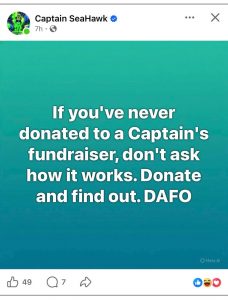
The individual, identified online as Wallace Watts, has become a visible presence at games and fan events connected to the Seattle Seahawks. Dressed in elaborate team-themed attire and frequently positioning himself in front of cameras, he has built a recognizable persona among segments of the fan base. However, recent social media posts and commentary have raised concerns about his fundraising efforts and the legitimacy of his claims.
According to critics, Watts has recently promoted online campaigns claiming to raise money for hundreds of prison inmates and for the son of Seahawks general manager John Schneider. In posts circulating widely among fan groups, Watts allegedly urged followers to donate money directly to him, discouraging questions about how funds would be managed or distributed.
No public evidence has surfaced confirming that the Seahawks organization or Schneider are affiliated with these fundraising efforts. The Seahawks have not publicly commented on the matter, and there is no indication that Watts holds any official role with the team.
Critics argue that the lack of transparency is concerning. Some online commentators claim Watts is currently under multiple investigations related to alleged scams, though specific details about any active cases have not been confirmed by public court records at the time of publication. Law enforcement agencies have not issued formal statements regarding ongoing investigations.
Watts has previously described himself as a passionate fan dedicated to charitable causes. His social media accounts often feature photos from team events, charity appearances, and game-day gatherings. To many casual observers, his visibility has made him appear closely connected to the franchise, despite no official affiliation.
That perception, critics say, is part of the problem.
“He’s become one of the most recognizable faces at games,” one longtime fan commented in an online discussion. “People assume he represents the team in some way, but he doesn’t.”
The Seattle Seahawks have long cultivated one of the NFL’s most engaged fan bases, often referred to as the “12s.” Fan culture plays a prominent role in the team’s identity, with costumed superfans and high-energy supporters frequently featured in broadcasts and promotional materials. However, teams typically maintain clear boundaries between official ambassadors and independent fans.
Sports law experts note that while fans are free to create personas and raise money for causes, fundraising activities can raise legal concerns if they involve misrepresentation, lack of transparency, or misuse of donated funds. In many states, charitable fundraising is subject to consumer protection laws that require disclosure about how funds will be used.
At this stage, there is no public documentation confirming wrongdoing by Watts. However, critics argue that asking donors not to question how funds will be handled is itself a red flag.
“Any legitimate fundraiser should welcome transparency,” said one nonprofit governance consultant. “Donors have a right to know where their money is going.”
The mention of raising money on behalf of John Schneider’s son has drawn particular attention. Schneider, who has served as general manager of the Seahawks since 2010, is a prominent figure within the organization. There has been no public announcement from Schneider or the team indicating a fundraising partnership with Watts.
In the absence of official confirmation, some fans have urged caution, advising others to donate only through verified channels connected directly to established charities or the team’s official foundation.
Watts’ critics also claim that despite not holding traditional employment, he appears to travel extensively and attend numerous events, raising questions among skeptics about his sources of income. However, personal financial details have not been independently verified.
Legal analysts caution against drawing conclusions without documented evidence. Allegations circulating online do not necessarily equate to criminal conduct, and individuals accused of wrongdoing are entitled to due process.
Still, the situation highlights the complex intersection of fandom, social media influence, and fundraising in the digital age. High-profile fan personas can quickly gain visibility and credibility, particularly when amplified by cameras and online platforms.
For the Seahawks organization, the controversy presents a reputational challenge. Although there is no indication the team is connected to the fundraising efforts in question, repeated public association between Watts and the franchise could create confusion among fans and potential donors.
Professional sports organizations often work carefully to protect their brand identity. Unauthorized use of team imagery or implied endorsement can sometimes lead to legal action if it crosses certain boundaries. Whether the Seahawks will address the matter publicly remains unclear.
Meanwhile, discussions among fans continue to intensify. Some argue that criticism of Watts is overdue, while others warn against trial by social media.
“It’s important to separate personal disputes from verified facts,” one fan wrote. “If there’s wrongdoing, let the legal system handle it.”
The broader issue touches on a growing concern across sports communities: how to ensure charitable efforts connected to fandom remain ethical and transparent. As digital platforms make it easier than ever to solicit donations, both donors and organizers face heightened responsibility.
Until official investigations, if any, yield findings, many questions remain unanswered. What is clear is that the controversy has sparked debate about accountability, representation, and the responsibilities that come with becoming a visible figure within a passionate fan base.
For now, fans are left navigating a mix of loyalty, skepticism, and concern — hoping that clarity, whether through official statements or legal proceedings, will ultimately bring resolution to a situation that has cast an uncomfortable spotlight on a community built around team pride.
Leave a Reply