On a day set aside to honor American presidents, it feels especially fitting to celebrate a man whose very name echoes the Oval Office — Lincoln Kennedy, the only NFL player to carry the names of two former U.S. presidents. But while his name sparks curiosity, it’s his dominance on the football field — particularly at the University of Washington — that cemented his legacy as one of the greatest offensive linemen in college football history.
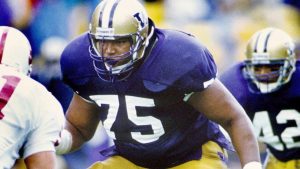
The Washington Huskies football have produced their share of standout linemen over the decades, yet Kennedy stands apart. Widely regarded as the finest offensive lineman ever to wear the purple and gold, he anchored the Huskies during one of the most successful stretches in program history.
From 1990 through 1992, Kennedy started in three consecutive Rose Bowls, a rare feat that underscores both his durability and elite level of play. Competing on college football’s grandest stage year after year, he established himself as the cornerstone of Washington’s offensive line — powerful, technically sound, and nearly impossible to move once he set his feet.
His rise was steady and undeniable. In 1990, Kennedy earned Second-Team All-Conference honors, signaling that national recognition was on the horizon. By 1991 and 1992, he elevated his game even further, earning First-Team All-Conference honors in consecutive seasons. Defensive linemen across the Pac-10 quickly learned that lining up opposite Kennedy meant facing one of the most imposing blockers in the nation.
The accolades kept coming. Kennedy was named a Third-Team All-American in 1991, and in 1992, he reached the pinnacle — a unanimous All-American selection. That same year, he won the Morris Trophy for the second straight season, awarded to the Pac-10’s top offensive lineman, as voted on by opposing defensive players. The honor carried special weight because it reflected the respect of those who battled him snap after snap.
Kennedy also captured the prestigious Jim Parker Award in 1992, given annually to the nation’s top offensive lineman. By the end of his college career, there was little debate: he wasn’t just one of the best in Washington history — he was one of the best in the country.
His impact extended beyond individual recognition. Kennedy was a key member of the 1991 Washington team that claimed a share of the national championship. That season remains one of the proudest chapters in Huskies football history, defined by physical dominance in the trenches and relentless execution. Kennedy’s presence on the line helped set the tone for an offense that overwhelmed opponents.
When the 1993 NFL Draft arrived, Kennedy’s draft stock reflected his elite status. He was selected ninth overall — a testament to how highly professional scouts valued his combination of size, technique, and football intelligence. Top-10 selections are reserved for players viewed as franchise cornerstones, and Kennedy fit that mold.
He began his NFL journey with the Atlanta Falcons before eventually finding his football home with the Oakland Raiders. It was in Oakland that Kennedy truly flourished, becoming one of the league’s premier right tackles.
From 2000 to 2002, Kennedy earned three consecutive Pro Bowl selections, solidifying his reputation as one of the NFL’s elite linemen. His performance during that stretch wasn’t just good — it was dominant. He combined brute strength with exceptional footwork, allowing him to protect quarterbacks against some of the league’s fiercest pass rushers.
In addition to his Pro Bowl honors, Kennedy was named All-Pro twice, including a First-Team All-Pro selection in 2002 — one of the highest individual distinctions an NFL player can receive. That season, he stood at the absolute peak of his profession, recognized league-wide as the best at his position.
Kennedy’s success culminated in a Super Bowl appearance with the Raiders during the 2002 season. While the team ultimately fell short of a championship, reaching the game itself underscored the caliber of the roster — and Kennedy was a central pillar of that offensive line.
Standing 6-foot-6 and weighing over 330 pounds during his playing days, Kennedy was an imposing figure. Yet those who know him often speak first not about his size, but about his character. Teammates, coaches, and fans alike describe him as kind, thoughtful, and gracious — qualities that have defined his post-playing career as much as his athletic accomplishments defined his time on the field.
After retiring, Kennedy transitioned into broadcasting and community engagement, remaining closely connected to both the NFL and the University of Washington. His voice, much like his presence on the line, carries authority and authenticity shaped by experience at the highest levels of the game.
Presidents’ Day is traditionally about leadership, legacy, and impact. In football terms, Lincoln Kennedy embodied all three. On the field, he led by example — disciplined, relentless, and unshakeable. His legacy is etched in Washington’s championship banners and in the NFL record books. And his impact continues through mentorship, commentary, and service.
It’s rare for a name to perfectly match a moment of recognition. But on Presidents’ Day, honoring a player named Lincoln Kennedy feels almost poetic. Beyond the novelty of carrying two presidential names, he built a career worthy of distinction in its own right.
From anchoring three straight Rose Bowl teams to earning unanimous All-American honors, from becoming a top-10 draft pick to earning Pro Bowl and All-Pro recognition, Kennedy’s journey reflects sustained excellence at every level.
He wasn’t just a great lineman. He was — and remains — a symbol of strength, perseverance, and integrity.
And on a day devoted to honoring leadership and legacy, Lincoln Kennedy stands as a reminder that greatness isn’t limited to politics or history books. Sometimes, it’s forged in the trenches — one snap at a time.
Leave a Reply