Change at the scale of a federal government rarely arrives quietly. When President Donald Trump announced that more than 270,000 federal jobs would be cut during his second term, the decision sent immediate shockwaves through Washington and far beyond. Supporters hailed it as a long-overdue correction to what they see as an oversized bureaucracy. Critics warned it would leave lasting scars on millions of American families. Between those two reactions lies a far more complicated story—one that blends political promises, economic statistics, and the very real human consequences of governing by the numbers.
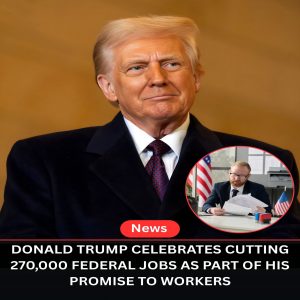
Standing before reporters, Trump framed the cuts as proof that he is, in his words, a “president for the workers.” He pointed proudly to a milestone his administration now celebrates: the lowest number of federal government employees since 2014. The message was clear and consistent with his campaign slogan—“Promises made, promises kept.” For Trump, shrinking the federal workforce was not just a policy choice, but a fulfillment of a long-standing pledge to rein in government and reduce what he often calls waste, inefficiency, and bureaucratic excess.
From a purely numerical standpoint, the administration’s argument is simple. Fewer government workers mean lower long-term payroll costs, reduced pension obligations, and a leaner state apparatus. Trump has repeatedly argued that the private sector, not Washington, should be the primary engine of job creation. In that vision, government should act as a facilitator, not an employer of last resort.
Yet numbers alone rarely tell the full story. Behind the headline figure of 270,000 eliminated jobs are people—clerks, analysts, inspectors, IT specialists, and support staff—many of whom had spent years or even decades in public service. For them, the cuts were not an abstract exercise in efficiency but a sudden disruption of livelihoods, healthcare plans, and retirement expectations.
The impact rippled outward. Each federal job supports a network of local economies, from small towns built around government offices to urban centers where federal salaries sustain housing markets and local businesses. Economists note that while government layoffs can reduce public spending in the short term, they can also depress consumer demand, especially in regions heavily dependent on federal employment.
This tension is playing out against a broader labor market backdrop that remains uneasy. While Trump often highlights strong headline indicators, the reality is more mixed. About 7.8 million Americans are still actively searching for work, and the unemployment rate stands at 4.6%. While that figure is far from crisis levels, it suggests that job security remains a concern for millions—particularly at a time when automation, artificial intelligence, and corporate restructuring are already reshaping the workforce.
Adding another layer of controversy to the story is the reported involvement of prominent tech leaders in the process. According to multiple accounts, figures such as Elon Musk were consulted to help make the federal government “leaner and more efficient.” Supporters argue that bringing in innovators from the private sector introduces fresh thinking and modern management practices to a system often criticized as outdated. They see it as a pragmatic step toward applying Silicon Valley-style efficiency to Washington.
Critics, however, view this collaboration with suspicion. They question whether tech executives—whose success has come largely from disruption and rapid downsizing—are well suited to shaping public institutions designed to provide stability, oversight, and essential services. For them, the fear is that efficiency becomes a euphemism for cuts made without sufficient regard for public impact.
Public opinion reflects this divide. Despite Trump’s confidence and visible pride in the job cuts, his approval rating sits at 39%. That number suggests that a majority of Americans remain unconvinced by his argument that these reductions ultimately serve workers’ interests. For many, the contradiction is hard to ignore: how can a president claim to champion workers while overseeing one of the largest reductions in government employment in recent history?
Supporters counter that federal workers are only one segment of the labor force, and that long-term economic growth depends on a vibrant private sector. They argue that the administration’s policies are designed to shift employment away from government dependency and toward industries driven by innovation and competition. In this view, short-term pain is the price of long-term prosperity.
Opponents see it differently. They argue that government jobs have historically provided stable, middle-class employment, particularly for veterans, minorities, and workers without access to elite private-sector networks. Cutting these positions, they say, risks widening inequality and undermining the very communities politicians claim to protect.
As the debate continues, one reality remains unavoidable: policy decisions made in Washington do not stay confined to spreadsheets and press releases. They echo in living rooms, unemployment offices, and dinner-table conversations across the country. Families forced to rethink budgets, postpone education plans, or relocate for work are living proof that governance is never purely theoretical.
Trump’s sweeping federal layoffs may stand as one of the defining economic moves of his second term. Whether history judges it as a bold act of necessary reform or a costly miscalculation will depend on what comes next—how the labor market absorbs displaced workers, whether promised efficiencies truly materialize, and whether Americans ultimately feel more secure or more exposed.
For now, the nation is left grappling with a central question that cuts through the political noise: when leaders celebrate efficiency and fulfilled promises, who is paying the price—and is it one the country is willing to accept?
Leave a Reply