Senator Bernie Sanders sharply criticized President Donald Trump’s actions toward Venezuela, questioning both their constitutional legality and the priorities driving U.S. foreign policy at a time of deep economic strain at home. In a forceful statement, Sanders argued that the president lacks the authority to launch military action against another country without congressional approval, warning that such decisions undermine the Constitution and risk dragging the nation into unnecessary conflict.
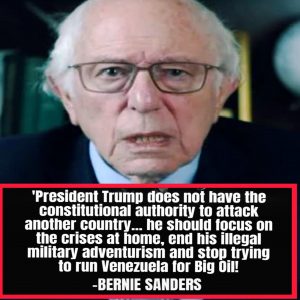
“President Trump does not have the constitutional authority to attack another country,” Sanders wrote, framing his objection as a defense of the separation of powers rather than a partisan dispute. He emphasized that the Founders deliberately placed the power to declare war in the hands of Congress to prevent unilateral military action by the executive branch. For Sanders, bypassing that safeguard represents not just a policy disagreement, but a fundamental threat to democratic governance.
Sanders’ criticism went beyond questions of legality. He drew a sharp contrast between foreign military action and the economic realities facing millions of Americans. “When 60% of Americans are living paycheck to paycheck,” he wrote, “the president should focus on the crises at home.” Sanders cited rising housing costs, unaffordable healthcare, and economic insecurity as urgent challenges demanding federal attention and resources.
The Vermont senator has long argued that U.S. foreign interventions often come at the expense of domestic investment. In his statement, he accused Trump of pursuing what he called “illegal military adventurism” while failing to address the everyday struggles of working families. He also rejected Trump’s rhetoric about exerting control over Venezuela, saying the United States has no right to “run” another sovereign nation.
Sanders suggested that economic interests, particularly in the energy sector, were influencing U.S. policy. He urged the president to “stop trying to ‘run’ Venezuela for Big Oil,” echoing a recurring theme in his political career: skepticism toward corporate influence in foreign affairs. According to Sanders, interventions framed as national security measures too often align with the interests of powerful industries rather than the needs of ordinary people.
Trump and his supporters have defended a hardline approach to Venezuela by pointing to the country’s long-running political and economic crisis. They argue that U.S. pressure is necessary to confront corruption, authoritarianism, and human rights abuses, and to protect American strategic interests. The administration has portrayed its actions as decisive leadership, contrasting them with what it calls years of ineffective diplomacy.
However, critics like Sanders warn that such justifications risk repeating past mistakes. He has consistently opposed regime-change operations, arguing that they often destabilize regions, cause civilian suffering, and fail to produce the democratic outcomes promised by their architects. From Iraq to Libya, Sanders and other skeptics point to interventions that left countries fractured and the United States entangled in prolonged conflicts.
The constitutional dimension of the dispute has also gained traction among lawmakers from both parties. Several members of Congress have argued that any sustained military action requires explicit authorization, regardless of the president’s party. They contend that allowing presidents to act unilaterally sets a dangerous precedent that erodes congressional oversight and public accountability.
Sanders’ statement reflects broader concerns within the Democratic Party about executive power. While Democrats remain divided on specific foreign policy approaches, many share the view that war-making authority has shifted too far toward the White House over the past several decades. Reasserting Congress’s role, they argue, is essential to restoring democratic checks and balances.
At the same time, Sanders’ emphasis on domestic priorities underscores a central theme of his political message. He has repeatedly argued that America’s greatest threats are not foreign adversaries, but inequality, corporate concentration, and the erosion of social safety nets. In his view, military action abroad distracts from addressing these systemic problems and drains resources that could be used to improve lives at home.
Public reaction to Sanders’ comments has been sharply divided. Supporters praised him for standing up for constitutional principles and for highlighting the disconnect between foreign intervention and domestic hardship. Critics accused him of downplaying security concerns and of reflexively opposing U.S. leadership on the world stage.
Political analysts say the clash reflects a deeper debate about America’s role in the world. One vision emphasizes strength, deterrence, and assertive action; the other prioritizes restraint, diplomacy, and investment at home. Sanders’ critique places him firmly in the latter camp, arguing that true national strength begins with economic security and democratic accountability.
As tensions over Venezuela continue to unfold, Sanders’ warning adds to growing pressure on the administration to clarify its legal rationale and strategic goals. Whether Congress moves to challenge or constrain the president’s actions remains an open question. What is clear is that the debate is no longer only about Venezuela—it is about who decides when the United States goes to war, and what the country chooses to prioritize in an era of profound economic and political change.
For Sanders, the answer is straightforward: protect the Constitution, end unauthorized military action, and focus on the urgent needs of Americans struggling to get by. Whether that message gains broader traction may shape not only the future of U.S. policy toward Venezuela, but the balance of power between Congress and the presidency itself.
Leave a Reply