Sen. Bernie Sanders has thrown a new flashpoint into Washington’s budget battles with an amendment that would rescind $75 billion in additional funding for U.S. Immigration and Customs Enforcement (ICE) and redirect that money to Medicaid. Framed as a stark moral and fiscal choice, the proposal argues that preserving health care for vulnerable Americans should take precedence over expanding immigration enforcement.
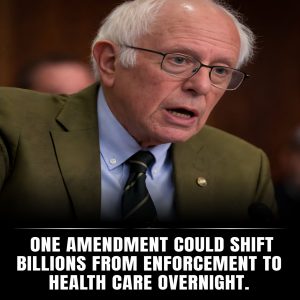
According to Sanders’ office, the reallocated funding could prevent an estimated 700,000 people from losing health coverage in the wake of what he describes as unprecedented, Republican-backed cuts to Medicaid. Those at risk, Sanders says, include low-income families, seniors, people with disabilities, and rural residents who rely heavily on the program for access to basic medical services. In his view, the amendment is less about immigration policy alone and more about national priorities.
“At a time when millions of Americans are struggling to afford health care,” Sanders said in a statement accompanying the amendment, “Congress should not be pouring tens of billions of dollars into aggressive immigration enforcement while slashing the medical lifeline for the most vulnerable people in this country.” The language of the proposal deliberately frames the issue as a zero-sum decision: fund ICE at historic levels, or protect Medicaid from deep reductions.
Medicaid, which provides health coverage to more than 70 million Americans, has long been a political battleground. Supporters see it as an essential pillar of the social safety net, while critics argue its rising costs strain federal and state budgets. Recent proposals to limit future Medicaid spending or tighten eligibility rules have reignited fears among advocates that hundreds of thousands could lose coverage. Sanders’ amendment seeks to counter those concerns by injecting new funds into the program at a critical moment.
Supporters of the amendment argue that investing in Medicaid is not only a moral imperative but also a fiscally responsible move. They point to studies suggesting that access to preventive care and consistent treatment reduces emergency room visits, lowers long-term health costs, and improves workforce stability. From this perspective, strengthening Medicaid could ease pressure on hospitals and state budgets while improving overall public health outcomes.
Progressive lawmakers and advocacy groups have also framed the proposal as a rebuke to what they view as the over-militarization of immigration enforcement. They argue that ICE has already seen significant budget growth over the past decade and that additional funding has not meaningfully addressed the root causes of migration. Redirecting funds to health care, they say, would produce more tangible benefits for communities across the country.
Critics, however, see the amendment very differently. Republicans and some centrist Democrats contend that the additional ICE funding is necessary to maintain border security and enforce immigration laws. They argue that reducing ICE’s budget could undermine enforcement operations, worsen backlogs, and send the wrong signal at a time when immigration remains a top concern for many voters.
Opponents also reject the premise that Medicaid and immigration enforcement must be pitted against each other. In their view, Congress should address health care funding through targeted reforms rather than by cutting resources from agencies tasked with national security and law enforcement responsibilities. Some lawmakers have accused Sanders of politicizing immigration to advance a broader ideological agenda centered on expanding government-run health care.
The amendment is unlikely to pass in a closely divided Congress, but its impact may extend beyond the final vote count. Budget amendments often serve as messaging tools, forcing lawmakers to go on record about their priorities. By framing the issue as “ICE versus Medicaid,” Sanders is drawing a clear contrast that could resonate with voters who feel squeezed by rising health costs and uncertain coverage.
The debate also highlights deeper philosophical divisions over the role of government. For Sanders and his allies, health care is a human right that should not be compromised by budgetary trade-offs. For critics, immigration enforcement is a core federal responsibility that cannot be weakened without consequences. The clash reflects long-standing tensions between social spending and security spending that have shaped U.S. politics for decades.
As the amendment moves through the legislative process, it is expected to spark intense floor debate and media scrutiny. Advocacy groups on both sides are already mobilizing, urging constituents to contact their representatives. Health care organizations warn of dire consequences if Medicaid funding shrinks further, while immigration hardliners argue that enforcement agencies are already overstretched.
Even if the amendment fails, it underscores a broader reality: Congress is heading into another high-stakes fight over budget priorities with no easy compromises in sight. Whether lawmakers ultimately side with expanded enforcement or expanded health care, the vote will signal how they define the federal government’s responsibilities in a time of fiscal pressure and political polarization.
For Sanders, the amendment is consistent with a career-long message—budgets are moral documents. The question now is whether that message can shift the conversation, or whether it will deepen the partisan divide over immigration, health care, and the limits of government action.
Leave a Reply