When the Seattle Mariners selected LSU left-hander Kade Anderson third overall in their most recent draft, it stirred excitement across the Pacific Northwest. A polished, highly touted lefty with frontline potential, Kade Anderson immediately became one of the crown jewels of Seattle’s farm system.
But longtime Mariners fans couldn’t help thinking about another Anderson — a towering 6-foot-11 flamethrower from the 1990s whose promise once felt limitless.
That Anderson was Ryan Anderson. And his story remains one of the most heartbreaking “what ifs” in franchise history.
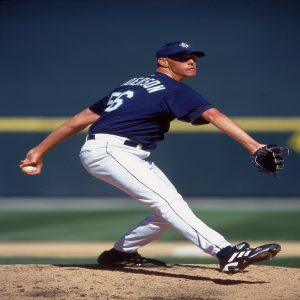
The “Little Unit”
When Seattle drafted Ryan Anderson out of high school, the comparisons came instantly. At 6’11”, throwing mid-to-upper-90s heat from the left side, he drew obvious parallels to Hall of Famer Randy Johnson — the legendary “Big Unit.”
Naturally, the nickname “Little Unit” followed him almost immediately. Broadcaster Wayne Cody even tried to spark a different moniker — “The Space Needle” — but the Randy Johnson comparison stuck. It was both a blessing and a burden.
In the late 1990s, baseball was different. Today, double-digit strikeout rates are common among elite starters. Back then, most starting pitchers averaged around seven strikeouts per nine innings. Power arms were rare. Dominant strikeout machines were even rarer.
Ryan Anderson was rare.
A Teenage Phenom
At just 18 years old in Single-A ball, Anderson posted a 3.23 ERA while striking out 152 batters in 111.1 innings. That translated to an astonishing 12.3 strikeouts per nine innings — a number that looked almost unreal for that era.
The following season, at age 19 in Double-A, he recorded a 4.50 ERA but fanned 162 hitters in 134 innings. The strikeout rate remained elite. Scouts saw a future ace. Mariners fans saw destiny.
By the time he entered the 1999 season, Anderson was ranked the seventh-best prospect in all of baseball. He followed that with a ninth-overall ranking heading into 2000. The buzz wasn’t just local — it was national.
Then came a moment that seemed to confirm everything.
In an exhibition game at Safeco Field against the Philadelphia Phillies, Anderson struck out 10 batters in just four innings in front of a sold-out crowd. The electricity in the stadium was undeniable. It was no longer a question of if he would pitch in Seattle — it was when.
On the Brink of Stardom
In 2000, at just 20 years old, Anderson was pitching for the Triple-A Tacoma Rainiers. He posted a 3.98 ERA while striking out 146 batters in only 104 innings — an eye-popping 12.6 strikeouts per nine innings.
He started the Futures All-Star Game during the All-Star break, a stage reserved for baseball’s brightest young stars. Everything pointed toward an imminent call-up to the majors.
The Mariners were contenders. They were building something special. Anderson was supposed to be the missing piece — the dominant ace who could anchor a championship rotation.
Then disaster struck.
The Injury That Changed Everything
Just as Seattle prepared to bring him to “the show,” Anderson blew out his arm. The injury was devastating. He never threw another pitch for the Mariners organization again.
Despite missing significant time, Anderson remained highly regarded — ranked eighth entering 2001 and 14th entering 2002. But rankings couldn’t fix a damaged arm.
From ages 18 to 20, Anderson had thrown 349.1 innings and recorded 460 strikeouts in just two and a half seasons. In hindsight, that workload feels staggering. Today, organizations carefully monitor young pitchers’ innings totals. Back then, development philosophies were different.
The Anderson saga is one reason why teams now exercise extreme caution with teenage arms.
For comparison, a modern prospect like Ryan Sloan logged only 82 innings with 90 strikeouts in Single-A — a fraction of the workload Anderson carried at the same age.
The Mariners’ Missing Ace
Between 2000 and 2003, Seattle enjoyed one of the most successful stretches in franchise history. They won 91 games in 2000, an astonishing 116 games in 2001, and followed that with back-to-back 93-win seasons.
Those teams were loaded with talent. They were disciplined. They were deep. They were dangerous.
But they lacked one thing: a dominant, homegrown ace in his prime.
Ryan Anderson was supposed to be that pitcher.
Imagine inserting a healthy, fully realized Anderson into those rotations. Would the postseason results have changed? Would a World Series banner hang at T-Mobile Park today? It’s impossible to know — but the question lingers.
That’s what makes his story so painful.
A Final Attempt
In 2005, Anderson resurfaced briefly, throwing 13.2 innings in rookie ball for the Milwaukee Brewers organization. He posted a 6.59 ERA. The velocity, the dominance, the aura — it was gone.
The game had moved on. His arm never fully recovered.
Unlike many prospects labeled as “busts,” Anderson never truly failed at the major league level. He never got the chance. Other hyped prospects at least reached the majors and proved they couldn’t stick. Anderson’s story is crueler — he was denied the opportunity to prove anything at all.
The Enduring “What If?”
Every franchise has its cautionary tales. For Seattle, Ryan Anderson stands alone.
He represents unrealized potential at its purest form — a pitcher who overpowered minor league hitters, dazzled scouts, and electrified fans, only to see it all vanish before his 21st birthday.
With Kade Anderson now entering the organization as a top draft pick, hope naturally returns. But the shadow of history remains. Mariners fans know that pitching prospects, no matter how gifted, walk a fragile line.
No one seems to know much about Ryan Anderson’s life after baseball. Those who remember him simply hope he found peace and fulfillment beyond the diamond.
Because for a brief, brilliant moment in the late 1990s, he looked like the next great ace — the heir to Randy Johnson, the towering force who would dominate the American League.
Instead, he became something else entirely: the greatest “what if?” in Mariners history.
And for those who watched him strike out 10 Phillies in four electric innings at Safeco Field, the memory still stings — a reminder that in sports, talent is precious, opportunity is fragile, and sometimes the biggest stories are the ones that never fully unfold.
Leave a Reply