President Donald Trump has ignited a political firestorm by demanding the rapid deportation of Democratic Representatives Ilhan Omar and Rashida Tlaib following a heated confrontation during his 2026 State of the Union address.
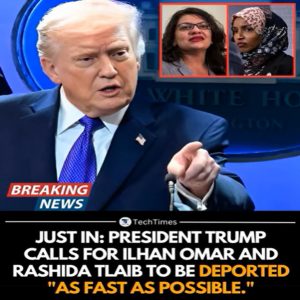
The dramatic clash unfolded on February 25, 2026, inside the House chamber, where tensions were already running high. As Trump delivered what would become a record-breaking 107-minute speech, Omar and Tlaib repeatedly interrupted from their seats, shouting, “You have killed Americans!” The protest was aimed at what they described as the administration’s harsh immigration policies and their broader human consequences.
The outbursts briefly disrupted the president’s address and drew visible reactions from lawmakers on both sides of the aisle. Some Republicans called the interruptions disrespectful and inappropriate during a formal joint session of Congress, while several Democrats later defended the protest as a reflection of deep moral and political disagreement.
The following morning, Trump escalated the confrontation through a social media post, labeling the two congresswomen “lunatics” and “corrupt politicians.” He went further, suggesting they be sent “back from where they came” immediately. The remarks quickly sparked widespread debate and condemnation.
Omar, who was born in Somalia and came to the United States as a refugee, became a naturalized U.S. citizen nearly three decades ago. Tlaib, meanwhile, was born and raised in Detroit, Michigan, and has been a U.S. citizen her entire life. Legal experts were quick to note that deportation is not legally applicable to American citizens, making the president’s demand symbolic rather than actionable.
The atmosphere inside the chamber during the speech was described by several lawmakers as unusually tense. House Speaker Mike Johnson later admitted he came “this close” to having both women forcibly removed from the floor for disrupting the address. Ultimately, no such action was taken, but the moment underscored the increasingly volatile tone of political discourse in Washington.
Trump’s speech also included remarks targeting Somali immigrants, whom he referred to as “pirates” during his address. Critics accused the president of using language that inflamed racial and ethnic tensions. Supporters, however, argued that his comments were consistent with his long-standing tough stance on immigration and border enforcement.
The confrontation marks the latest chapter in a year of intensifying political friction between the president and progressive lawmakers. In early 2026, Trump announced that the Department of Justice would investigate Omar’s personal finances, a move that drew sharp criticism from Democrats who described it as politically motivated. The investigation has added another layer of hostility to an already combative relationship.
Omar has consistently rejected the president’s accusations and characterized his rhetoric as a calculated attempt to energize his political base. Following the State of the Union clash, she reiterated that her protest was rooted in policy disagreements and concern for immigrant communities. Tlaib similarly defended her actions, stating that speaking out during moments of national attention is part of her responsibility as an elected official.
Political analysts say the episode reflects a broader shift in how high-profile political disagreements are playing out—often in public, highly personal, and emotionally charged ways. With the 2026 midterm elections approaching, confrontations like this are likely to intensify as both parties seek to mobilize voters.
For Trump, who has built much of his political brand around strong rhetoric and confrontational exchanges, the clash may reinforce support among his core base. His campaign messaging has frequently centered on immigration enforcement, national security, and criticism of progressive Democrats. By framing Omar and Tlaib as emblematic of what he calls “radical politics,” he may aim to sharpen partisan contrasts ahead of November.
At the same time, Democrats are likely to use the president’s deportation comments to rally their own supporters. Civil rights organizations and advocacy groups quickly condemned the remarks, arguing that they echo past controversies involving similar rhetoric directed at minority lawmakers.
Constitutional scholars emphasize that U.S. citizenship carries full legal protections, including protection from deportation. Once an individual becomes a citizen—either by birth or through naturalization—the government does not have the authority to revoke that status absent extremely rare and specific legal circumstances, none of which apply in this case. As a result, Trump’s call for deportation is widely viewed as a political statement rather than a legal proposal.
Still, symbolic statements can carry significant weight in a deeply polarized political climate. The personal nature of the attack, combined with the public setting of the confrontation, has fueled intense debate across media platforms and among voters.
As the midterm season kicks off, the clash between Trump and the two congresswomen may become a defining flashpoint in the national conversation. It highlights not only ideological divides over immigration and executive authority but also broader questions about civility, institutional norms, and the boundaries of political speech.
With both sides digging in, the incident signals that the road to the 2026 elections will likely be marked by sharp rhetoric and high-stakes confrontations. Whether voters see the exchange as justified protest, inappropriate disruption, or inflammatory political theater could shape the tone—and possibly the outcome—of the months ahead.
Leave a Reply