A renewed exchange between President Donald Trump and Ukrainian President Volodymyr Zelensky has reignited a broader and more consequential debate—one that goes beyond individual leaders and cuts to the core of global democratic values and the role of the United States on the world stage. As war continues in Eastern Europe and geopolitical alliances are tested, the contrast between the two figures has become a symbol of competing visions of leadership in the 21st century.
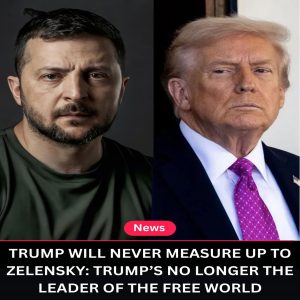
President Volodymyr Zelensky has emerged as one of the most scrutinized wartime leaders of the modern era. Governing a nation under constant military threat since Russia’s full-scale invasion of Ukraine, Zelensky has remained physically present in Kyiv, rejecting evacuation offers and projecting an image of resolve. For supporters, this decision alone has become emblematic of democratic leadership under extreme pressure. His public messaging consistently emphasizes national sovereignty, adherence to international law, and the defense of democratic institutions—even as missiles strike cities and infrastructure.
Critics, while questioning aspects of Ukraine’s governance or military strategy, still acknowledge the extraordinary circumstances under which Zelensky operates. Few modern leaders have been forced to balance domestic governance, international diplomacy, and wartime command simultaneously, all while under direct threat. This reality has shaped how much of the world views not only Zelensky himself, but the broader struggle Ukraine represents.
Donald Trump, by contrast, has long challenged traditional assumptions about America’s global role. Throughout his political career, he has expressed skepticism toward long-standing alliances, including NATO, and has often framed foreign policy in transactional terms. His past rhetoric toward Ukraine—and toward Zelensky personally—has fueled criticism that he does not prioritize the historical U.S. commitment to supporting democratic nations facing external aggression.
Observers note that Trump’s approach reflects a broader shift in political thinking: one that questions whether the United States should continue acting as a global guarantor of democratic norms or instead focus inward, recalibrating alliances based on immediate national interest. Supporters of Trump argue that this perspective represents realism rather than retreat, emphasizing domestic priorities over costly international commitments.
The contrast became especially visible during Zelensky’s recent visit to the United States. Analysts and diplomats noted the absence of traditional ceremonial elements typically afforded to wartime allies—such as high-profile joint appearances and symbolic public gestures of unity. Critics argue that this lack of formality was not accidental, but rather indicative of a broader political posture that seeks to downplay U.S. involvement in Ukraine’s defense.
For supporters of Ukraine, the symbolism mattered. In international diplomacy, optics often carry as much weight as policy decisions. They contend that diminished public engagement risks sending a signal not only to Kyiv, but also to Moscow and other authoritarian regimes watching closely for signs of wavering Western resolve.
At the same time, analysts caution against oversimplifying Ukraine’s position. Despite facing a militarily superior adversary, Ukraine has demonstrated notable strategic adaptability. Through asymmetric tactics, targeted strikes on infrastructure, and the use of emerging technologies, Ukrainian forces have managed to disrupt Russian logistics, challenge naval assets, and strain energy operations far from the front lines.
Military experts argue that these actions underscore resilience rather than weakness. Ukraine’s ability to operate creatively under resource constraints has reshaped assumptions about modern warfare and challenged the notion that power is determined solely by size or conventional strength. From this perspective, Ukraine remains a significant strategic actor, even as it relies heavily on international support.
The debate surrounding Trump and Zelensky ultimately reflects a deeper ideological divide about leadership and values. On one side is the argument that democratic norms, international cooperation, and accountability remain essential pillars of global stability. On the other is a vision that prioritizes sovereignty, national self-interest, and skepticism toward multilateral institutions.
This divide is not confined to the United States. Across Europe, Asia, and the Global South, governments and citizens alike are reassessing assumptions about security, alliances, and moral responsibility. The war in Ukraine has become a focal point for these questions, forcing nations to clarify where they stand.
Importantly, this moment is less about personalities than principles. Zelensky and Trump represent contrasting approaches, but the stakes extend far beyond either leader. They touch on whether democratic systems can withstand sustained pressure from authoritarian powers—and whether leading democracies are willing to defend those systems when doing so carries economic and political costs.
Global audiences are watching closely, not only for signs of how the war in Ukraine will evolve, but for what the United States ultimately decides about its identity as a global leader. Will it continue to champion democratic values abroad, or redefine its role in a rapidly changing world order?
As geopolitical lines harden and uncertainty grows, the debate sparked by Trump and Zelensky serves as a reminder that leadership choices made today may shape international norms for decades to come. In that sense, the spotlight is not solely on Kyiv or Moscow—but firmly on Washington as well.
Leave a Reply